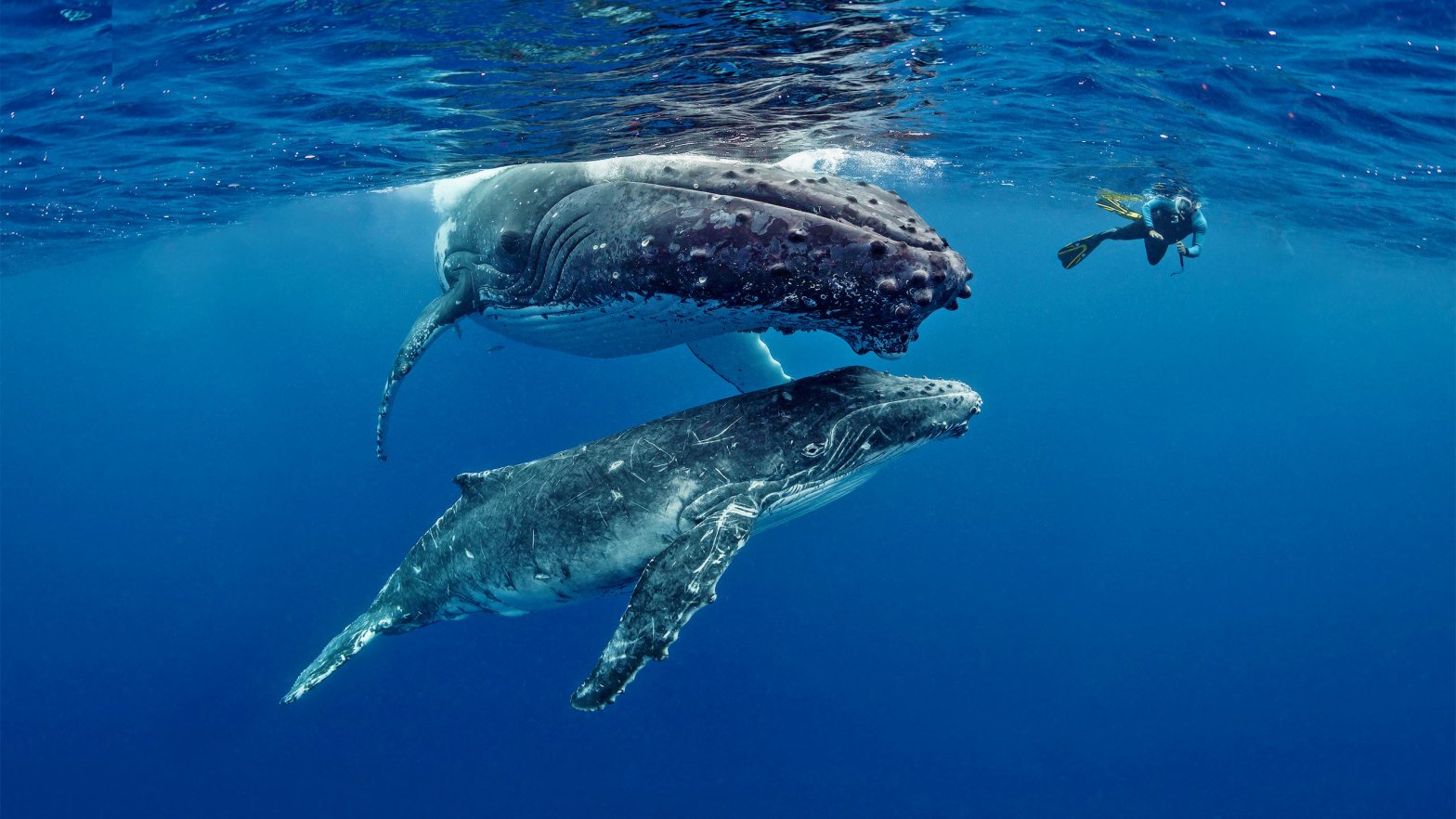
Humpback whales, (Megaptera novaeangliae) are found in every ocean in the world, and they can live up to 45-50 years old. Their Latin name translates to “Big Wing of New England”, so, “Big Wing” refers to their pectoral fins which can grow to a huge 16ft long (largest in the world), and “of New England” obviously refers to their appearance off the coast of New England where the European whalers first encountered them.
These whales are baleen whales, and they are actually covered in hair. It’s obvious they aren’t a fluffy animal, but instead they have around 100 fragile hairs dotted along their jaw. Their heads are broad, rounded and covered with bumps that are called tubercles, (they are around the size of your fist). Tubercles are essentially over sized hair follicles, and within each tubercle is a bundle of thick nerve cells that are connected to the hair, which then sticks up a few centimeters out the top. The reasoning behind these tubercles is a mystery, scientists have absolutely no clue what they are used for but there are many ideas that have been raised over the years, for example, its been said that these tubercles are most likely used to help the whale feel different vibrations in the water to help them build a better picture of their surrounding environment.

They can grow to around 60ft (relative to the size of a bus), they can weigh up to 40 tonnes (about half the size of a blue whale), and their tails can grow up to 18ft wide! They are black on the doral (upper) side and mottled black and white on the ventral (under) side.
Humpback whales have ventral pleats that start from the tip of their bottom jaw and go all the way down, they can have anywhere from 14-35 of the pleats along their necks. These pleats serve an important purpose, they actually increase the volume of the mouth area which increases the intake of potential food. The shape and colour pattern of the dorsal fin and flukes is unique to each whale, essentially like human fingerprints. This unique pattern of each whale has helped researchers identify, catalog and monitor humpback whale migration, population size, sexual maturity and behavioral patterns over the years.

Humpback whales migrate throughout the oceans all around the world, in the summer many humpbacks spend their time in high-latitude feeding areas such as the Gulf of Alaska or the Gulf of Maine. Whereas in the winter, they swim to the warmer waters that are closer to the Equator, such as Hawaii, South America and Africa. Humpbacks migrate farther than any other mammal, they can travel around 3,000 miles between their feeding and breeding grounds on a regular basis. But, the humpbacks found in the Arabian sea stay there all year round, feeding and mating in that same area. These whales hunt and feed in the summer, and fast during the mating season, then live off the blubber reserves so they can focus on their migration and mating.
A female humpback whale has a baby every 2-3 years, she is pregnant for around 12 months. Newborn calves weigh around one tonne when they’re born and are around 10-15ft long.

Humpbacks usually travel alone, but can sometimes be found in small pods of maybe 2 or 3 whales. Whale mothers and calves communicate with each other when they are traveling by touching fins as a possible sign of endearment.
These whales absolutely love to breach, this is where they spring themselves out of the water and splash back down rather hard and fast. It’s been said that this behaviour could be due to the whales wanting to remove parasites from their bodies, but they could just do it because they find it fun! Humpback whales also slap the water surface with their tails and flippers, these behaviours could be used to communicate with one another. It’s also said that they could also do this to show dominance and health during the mating seasons.


Humpback whales are most known for their songs, these songs are made up from a complex sequence of moans, howls, and cries that usually continue on for hours. Although both male and female whales make sounds, only male whales can produce organized songs, scientists believe it is used as a technique to attract mates. These songs can be heard from 20 miles away, these sounds usually have an audio frequency between 80 and 4000 hertz. Whale calves have been found to make very quiet vocalisations while migrating to the feeding grounds with their mothers. This behaviour between mother and calf has been nicknamed, “whale whispering” and is suggested that its used to help the two stay under the radar of nearby killer whales (Orcas).
As mentioned earlier, humpbacks are baleen whales, so rather than having teeth they have around 270-400 fringed overlapping plates that hang from each side of their upper jaw, these are called baleen plates. These plates are made from keratin and are around 30 inches long, and keratin is what our nails and hair are made from. The diet of a humpback is mostly small fish, krill and plankton. When they eat their prey, they take large gulps of water and this is where the ventral pleats come in by expanding in order to hold the water. The baleens then filter the water and the two blowholes that are found on the whale’s back then expel the water. They have a unique hunting method, that’s been called “bubble netting”. They hunt in groups where they use air bubbles to herd, corral and disorient the fish, they can also eat up to 3,000lbs a day.

 Cool Facts About The Ocean That No One Asked For