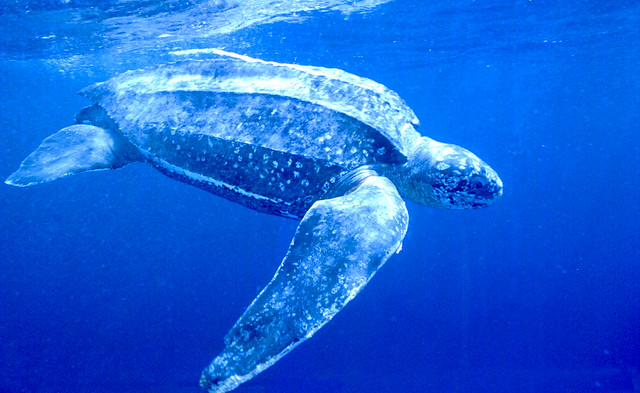
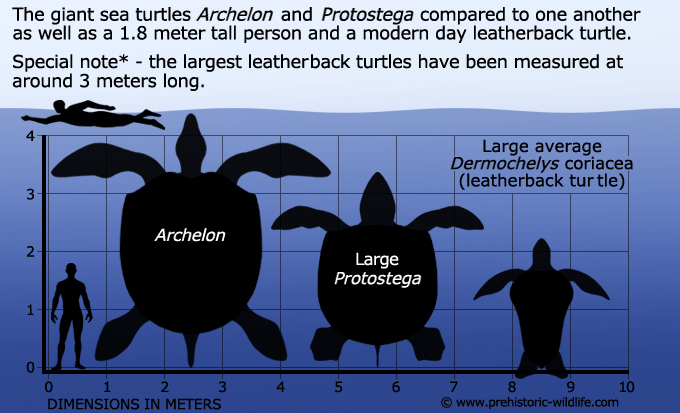
The Leatherback sea turtle ( Dermochelys coriacea ) is the only reptile that remain the representatives of a family of turtles that trace their evolutionary roots back to more than 100 million years. The Archelon ( Archelon ischyros ) sea turtle went extinct around 70 million years ago and until recently it was thought that the Leatherback turtle was it’s closest living relative, but now is said that the family Protostegidae come from a completely different lineage from any living sea turtle today.
The Leatherback is the biggest living sea turtle on earth and are one of the heaviest reptiles, coming fourth behind 3 species of crocodiles. They can grow to an impressive average size of 7ft (84 inch, 2.13 metres), and can weigh up to 2,000 pounds (907kg). The largest Leatherback recorded was almost 10ft (3 metres) from the tip of it’s beak to the tip of it’s tail and weighed around 2,019 pounds (916kg).
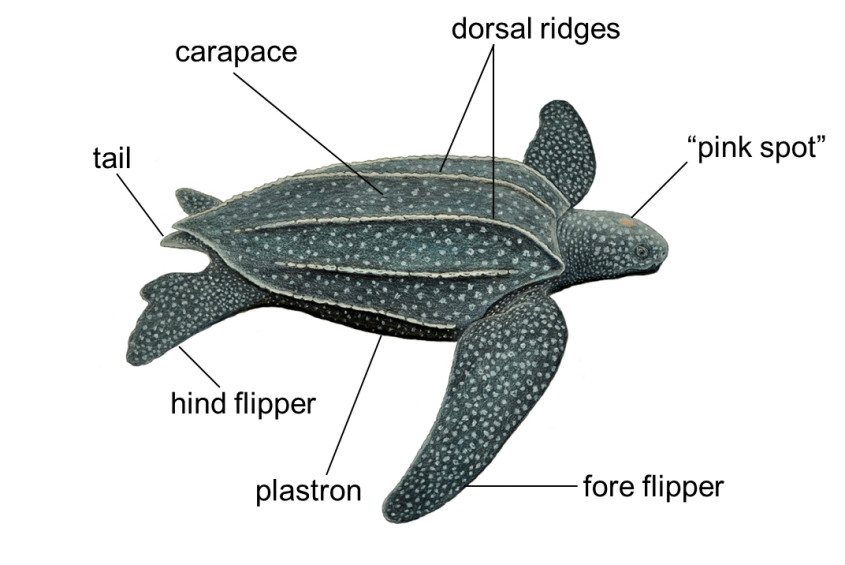
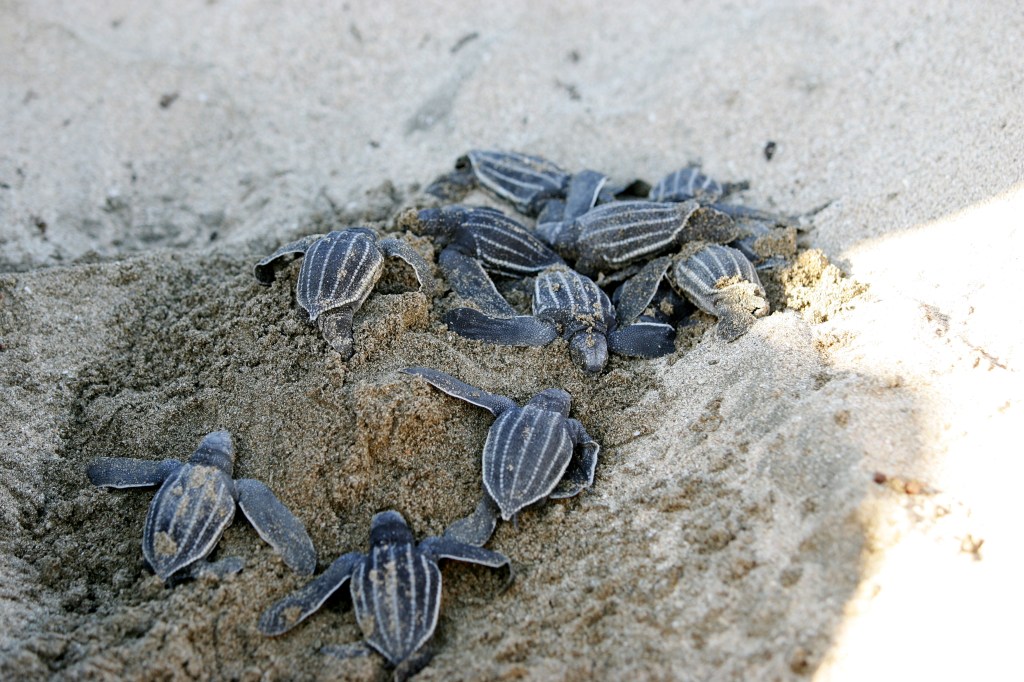
They’re more impressive than the other 6 species of sea turtles, and can dive deeper than 3,000ft (914.4 metres) and can stay down for around 85 minutes. It is the only sea turtle that lacks a hard shell and possesses a composed layer of thin, but tough, rubbery skin which is strengthened by thousands of tiny bone plates. The carapace (the dorsal upper section of a shell / exoskeleton) does not possess any scales, but scales are found in hatchlings. The carapace is typically a dark grey/black with white or pale spots, the pastron (lower half of shell/exoskeleton) is whitish to black and is marked by 5 ridges. The ridges are what distinguish the Leatherback from the other species of sea turtles, and help give the turtle a more hydrodynamic structure and are located along the entire body. The Leatherback can swim thousands of miles over open ocean and against fast currents thanks to its streamlined body and powerful front flippers.
These turtles are mainly found in open ocean, and yet have the widest global distribution of all reptile species. They’re mainly found in tropical waters but have been found to travel as far north as Canada and Norway, and as far south as the southern tip of Africa, and it has been found that they feed in areas just offshore. Leatherbacks have been recorded to be active in water temperatures below 4 degrees Celsius (40 degrees Fahrenheit), these are the only reptiles known to be so active at such a low temperature.
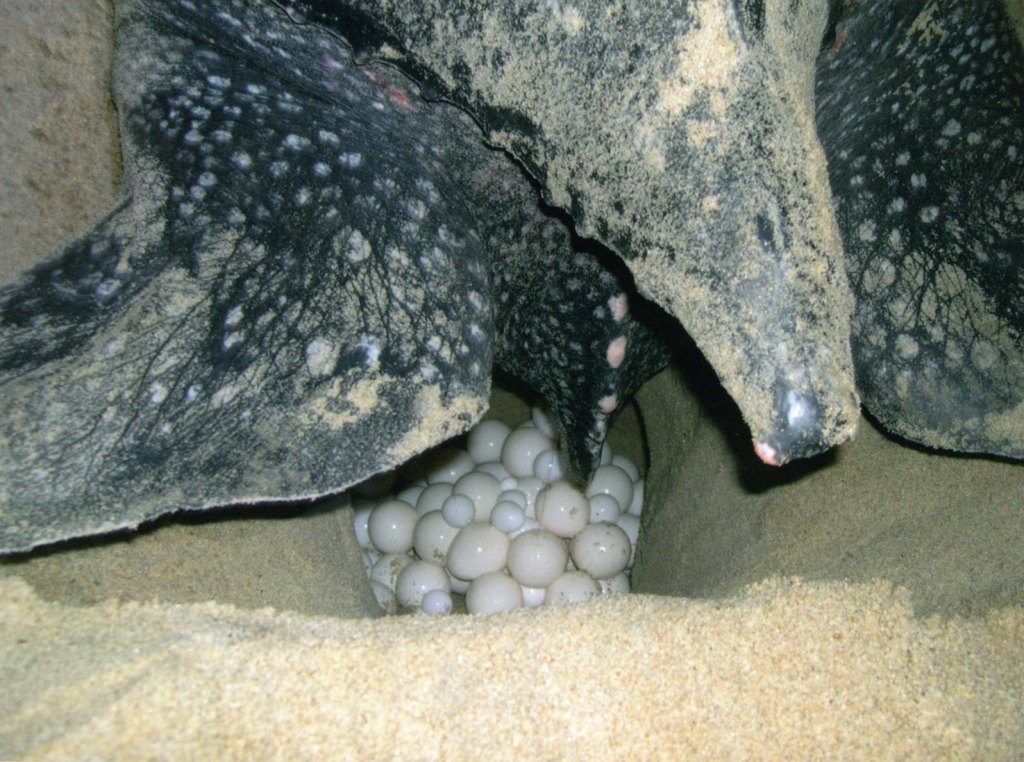
Male Leatherbacks never leave the ocean once they enter it, unlike females who leave to nest on land. Mating takes place at sea and after encountering a female the male will use head movements, nuzzling, biting and flipper movements to determine her receptiveness. Males can, and will, mate every year but females only mate every 2-3 years. Multiple males will typically mate with a single female. Leatherbacks undertake the longest migrations between breeding and feeding areas, averaging 3700 miles ( 5,954 km) each way. Once the female is ready, she will come ashore during the breeding season to nest. This important nighttime ritual involves making a hole in the sand, and laying around 110 eggs (this is called a clutch), filling the nest and then leaving a large, disturbed area of sand that makes it harder for predators to detect, after all this hard work they then return to the sea. It takes around 65-80 days for the eggs to hatch, and as sea turtles do not guard their nests, the hatchlings are left to defend for themselves. It’s estimated that only 1 in 1,000 Leatherback hatchlings will survive to adulthood, due to the threat of humans digging up the nests and consuming the eggs.
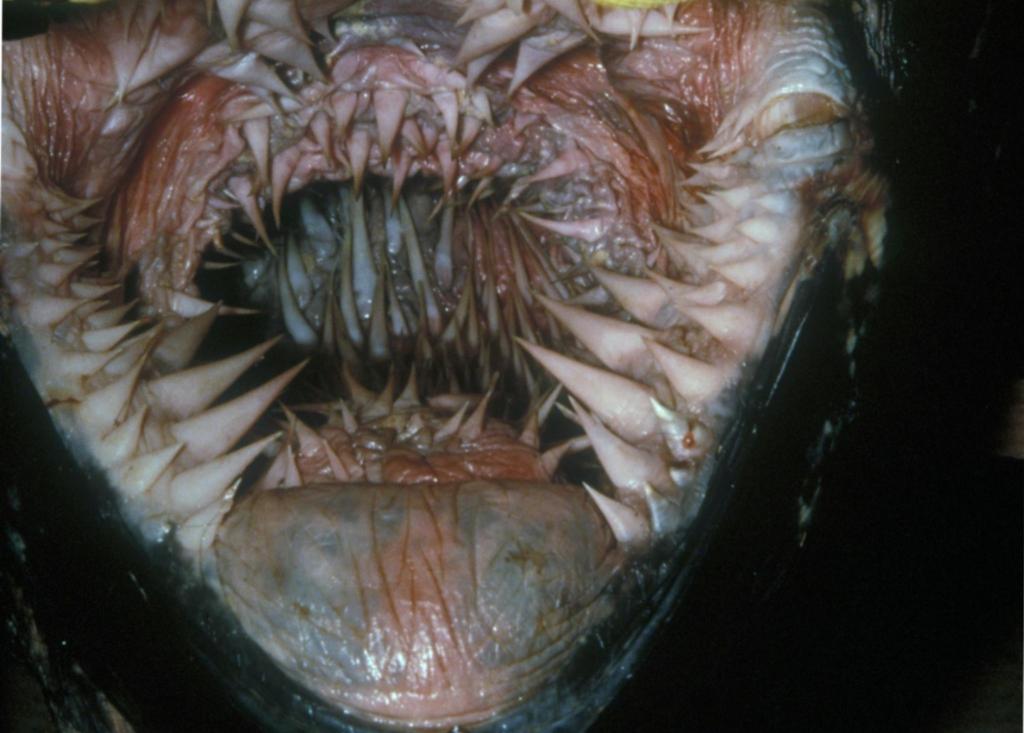
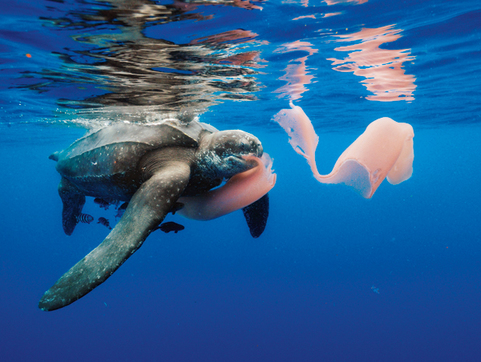
The diet of a Leatherback is mainly very soft organisms, such as jellyfish. Even though their size is impressive, they have relatively fragile jaws. Rather than teeth, leatherbacks have sharp beaklike cusps that help them grasp prey in their mouth, while the spines in their throat (papillae) help ensure that it doesn’t slip back out as the turtle uses the muscles in its throat to expel the excess salt water. These spines also protects the turtle from the jellyfish stings. It’s a wonder how these turtles can survive on just jellyfish, as they are mainly water and have very little protein, some minerals and vitamins and very little fat. These turtles actually have an extremely long esophagus that leads from the mouth to the rear of the body, it then loops up the side until it reaches the stomach. This long esophagus acts as a holding pouch, so that the Leatherback can continuously digest its food, while new jellyfish are being pushed into its stomach. This helps them travel the long distances and helps preserve their energy.
Unfortunately, leatherbacks meet an early end due to human activity. They fall victim to fishing lines and nets, and are even struck by boats. Leatherbacks, like most sea turtles, call victim to the floating plastic debris which they mistaken for their favourite food: jellyfish. Some leatherbacks have been found to have almost 11 pounds (4.98kg) of plastic in their stomachs. In some countries that the leatherback go to nest, the human population kill and harvest the meat, using it to feed their families. It has been said that the overall population of Leatherback sea turtles is declining and have been listened as “vulnerable”.
To help with the Leatherback population, start by refusing single use plastics and looking online at what you can do to help, even if it is donating a small amount to help protect their eggs from being harvested by humans!
 Cool Facts About The Ocean That No One Asked For